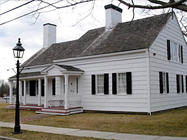
Oldest House in Westhampton Beach
The Foster-Meeker House, circa 1735 based on its surviving structural features (primarily an extensive, intact framing system), appears to be the oldest surviving building in Westhampton Beach (formerly Ketchaponack, meaning “a place where large roots grow”). Ketchaponack was initially settled in the 1730s after the original Southampton community expanded westward following the 1666 Quogue Purchase by the Southampton proprietors and subsequent division into Catcheponack (Ketchaponack), Potunk, and Onuck (Oneck) Necks (of land) in 1683. These western lands were used primarily for haying, grazing, and hunting and developed slowly due to their distance from the Southampton community and inherent geographical constraints.
We are excited about the newest phase of the Foster-Meeker Heritage Center project. At completion of this phase, we will have a living example of an 18th century colonial home set up to visibly demonstrate the life and construction techniques of that period and that can be used as a venue for teaching programs and other Society activities. The Westhampton Beach Village and Building Department has given us a permit to complete the work, which will provide us with the certificate of occupancy necessary to begin using the facility for public outreach and small events. The only outstanding work will be equipping the house with full electric and plumbing, none of which will disrupt the work completed during this phase.

The original Westhampton center of settlement was known as Beaverdam and was associated with a water-powered mill established in 1746 at the head of Beaverdam Creek, which separated then-Speonk from the Onuck and Potunk Necks. An early church and school (now gone) and cemetery (still present) were also located in the Beaverdam settlement area. The Ketchaponack area was only sparsely settled at that time and did not become more fully developed until the 1800s. Ketchaponack was formally renamed and incorporated as the Village of Westhampton Beach in 1928. As the apparent sole survivor of Ketchaponack’s early settlement period, the Foster-Meeker House provided an opportunity to preserve, restore, and interpret the earliest European chapter in our history.
Architecturally, the Foster-Meeker House derives its significance from it being a surviving mid-1700s post-and-beam Cape Cod type dwelling. Characteristically low to the ground and compact in appearance, the Cape Cod dwelling expressed a unique response among early Long Island settlers to an exposed environment with high winds, hurricanes, and other natural coastal phenomena.

Despite the architectural evidence that clearly places the House’s original construction in the mid-1700s, the earliest documented owner was Josiah Foster, who is believed to have acquired it about 1835 from Stephen Russell. Although Stephen Russell is said (Augusta Meeker to Beatrice Rogers) to have purchased the House from a Grant Bowers, it is possible that William Russell, who reportedly acquired lands here in 1663 prior to the Quogue Purchase, may have been the first owner. Josiah Foster was a descendant of the prolific local Foster family, among the first original Southampton settlers to populate the Westhampton/Quogue area. A cobbler by trade, Josiah maintained the House unaltered through the 1800s, leaving it to his daughter Susannah (Foster) Meeker on his death in 1885.
Miss Augusta S. Meeker, Josiah’s granddaughter, inherited the House upon the death of her mother, Susannah, in 1908 and maintained the House unchanged until her own death in 1957. Miss Meeker served as the librarian and in other functions at the Westhampton Free Library from 1902, when it was first chartered by New York State, until she resigned in 1937. Miss Meeker was well known in the Village and the Historical Society is fortunate to have a number of artifacts from her home. After Augusta’s death, alterations and additions were undertaken by a new owner who made a conscious effort to maintain the original look and feel of the House and preserve the original form and structural frame.
The Westhampton Beach Historical Society, recognizing that the Foster-Meeker House was one of the oldest extant structures in the Village, documented the building, secured funding, and moved the House to a new, permanent location when it was threatened with demolition in 2008. The Historical Society the listed the House on the New York State and National Registers of Historic Places and developed a restoration/reconstruction plan with the intent to use the House for educational programs. To recognize both the history of the House and its new purpose, it was re-named the Foster-Meeker Heritage Center.


Restoration and reconstruction have proceeded in phases. With the help of many generous private donors the initial phase of work, which included restoration of the timber frame and reconstruction of the entire building exterior, was completed in 2014. An ADOPT A WINDOW Program launched during this first phase enabled installation of authentic reproduction windows throughout the House. With the historic frame of the House fully protected, in 2015 period-appropriate steps and an ADA-compliant ramp were added to make the Heritage Center fully accessible, thanks to a grant obtained from the Robert D. L. Gardiner Foundation. In 2016 we developed plans for the completion of the interior of the Heritage Center and obtained a matching grant from the Robert D. L. Gardiner Foundation to help fund this effort. The interior work will be ongoing and includes reconstruction of the central fireplace and chimney complex and installation of period-appropriate staircases. Completion of this phase will enable our historic education programs to include demonstrations of 18th Century life.
Preservation and restoration of the Foster-Meeker Heritage Center ensures that this important regional expression of mid-Eighteenth Century Long Island domestic architecture is maintained for future generations. Your tax-deductible donation towards this project is most appreciated as it will assist the Society in fulfilling our commitments for matching grant funds.
Sources:
— Rogers, Beatrice G., 1953. Historical Sketch of the Incorporated Village of Westhampton Beach, N.Y.
— Studenroth, Zachary, 2009. New York State and National Historic Registers Nomination, Foster-Meeker House.
— Westhampton Beach Historical Society archives.
